Vermont · 9 V.S.A. 4503

Vermont ESA laws and who actually enforces them

Vermont does something few states do: fair housing enforcement is split between the Human Rights Commission and the Attorney General’s Civil Rights Unit, depending on the housing involved. Sending a complaint to the wrong one costs you time you may not have.

Start free screening Which enforcer
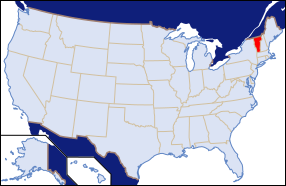
Map of the United States with Vermont highlighted

Vermont’s split

Two enforcers, and it matters which one

Most states have a single civil rights agency for housing. Vermont divides the work, so the first question after a refusal is not what to say but where to send it.

Vermont Human Rights Commission

Handles a defined set of housing discrimination matters under state law, investigating complaints and seeking resolution.

Start here if: your situation falls within the Commission’s housing jurisdiction — confirm scope with them directly before filing.

Attorney General’s Civil Rights Unit

Handles other categories of fair housing enforcement in Vermont, with the powers of the Attorney General’s office behind it.

Start here if: your matter falls outside the Commission’s remit. A quick call to either office will tell you which applies.

HUD, federally

The federal Fair Housing Act route, available regardless of which Vermont body has state jurisdiction.

Start here if: you want a parallel filing, or the state position is unclear and a deadline is approaching.

Educational overview. Confirm current jurisdiction with the office before relying on it.

Broader than federal

Housing and public accommodations in one Act

The Vermont Fair Housing and Public Accommodations Act deals with both in a single statute. For an assistance animal handler that is genuinely useful, because it means one body of state law covers your home and the places you go.

It does not, however, turn an emotional support animal into a service animal. Public access still follows individual task training under the ADA, in Vermont as everywhere.

Your rented homeCovered
A condominium associationCovered
Public accommodations (state law)Covered
ESA access to shops and restaurantsNot a right
Task-trained PSD in publicADA applies

Boundaries

Six things Vermont renters ask about limits

Can they charge a pet deposit once approved?

No. Charges applied because an animal is a pet do not carry over to an approved assistance animal. Damage liability remains yours.

Can they enforce a weight limit?

Generally not. Weight and breed limits are pet policies; an objection has to concern that individual animal’s conduct.

Can they ask what my diagnosis is?

No. Reliable information about a disability-related need is the limit. Decline records requests in writing and offer verification instead.

Can they say no because it is an old building?

Building age is not a lawful basis. Genuine structural undue-burden arguments are rare and must be evidenced, not asserted.

Can they require a specific vendor or registry?

No. No registry creates rights in Vermont or anywhere, and a landlord cannot require you to purchase anything.

Can they take longer because they are a small landlord?

A reasonable time is expected regardless of size. Ask for a decision date in writing if it drifts.

Deposits and pet charges

Vermont addresses assistance animal charges directly

9 V.S.A. 4503 is unusually explicit for a small state: a housing provider may not impose extra charges on a tenant because of an assistance animal, while remaining entitled to recover for damage the animal actually causes.

No additional deposit

A pet deposit is an extra charge imposed because of the animal, and it does not apply to an approved assistance animal in Vermont.

No pet rent

Recurring or one-off, the analysis is the same. The charge exists because of the animal, so it does not attach.

No breed surcharge

Objections must concern this animal’s conduct rather than its breed, size or an insurer’s preference.

Damage remains recoverable

Vermont preserves this expressly. Your security deposit and your liability for damage are untouched.

Validity and renewal

How long does a Vermont ESA letter last?

Vermont sets no expiry date. 9 V.S.A. 4503 governs what a housing provider may and may not do; it does not date your documentation, and the Vermont Human Rights Commission registers nothing.

Why do landlords say a year?

Because that is the convention for treating documentation as evidence of a current need. It has no statutory basis but is applied consistently.

Can they ask repeatedly?

Once a year is reasonable. Repeated short-interval demands after reliable documentation has been supplied are worth documenting.

Does an out-of-state letter work?

Rarely without challenge. Vermont borders New York, New Hampshire and Massachusetts, and none of those licences carries here.

What should a renewal involve?

A genuine reassessment by a Vermont-licensed professional, dated and independently verifiable.

Different pathway

Psychiatric service dogs in Vermont

Vermont follows the ADA for public access, and the Vermont Fair Housing and Public Accommodations Act protects people with disabilities in both housing and public accommodations.

Because the Act covers public accommodations as well as housing, a Vermont handler of a task-trained service dog has a state basis alongside the federal one.

Quick check

Vermont law reaches public accommodations too. Which pathway you need still turns on trained tasks.

Compare ESA and PSD Free screening

Vermont questions

Asked most often in Vermont

Who enforces fair housing in Vermont?

Enforcement is shared. The Vermont Human Rights Commission handles a defined set of housing matters, and the Attorney General's Civil Rights Unit handles others. Confirm which covers your situation before filing, because sending it to the wrong body wastes weeks.

Does Vermont law protect more than federal law?

The Vermont Fair Housing and Public Accommodations Act covers housing and public accommodations together, which is broader in scope than the federal Fair Housing Act alone. HUD also remains available in parallel.

Can a Vermont landlord charge pet rent for an approved ESA?

No. An approved assistance animal is outside the pet policy and its fee schedule. Vermont's Human Rights Commission investigates continued charging under 9 V.S.A. Section 4503. You remain responsible for damage the animal causes.

My Vermont landlord owns just one rental property.

Small landlords are common in Vermont and are not automatically exempt. Some very small owner-occupied situations fall within exemptions, so ask for the basis in writing rather than assuming either way.

Does Vermont require a waiting period for an ESA letter?

No. Vermont imposes no minimum client-provider relationship period. Your clinician must hold a Vermont licence and the evaluation must be genuine.

Do ESA letters expire in Vermont?

Indefinitely, as far as Vermont law is concerned — there is no statutory shelf life. Most offices want documentation issued within the last twelve months before treating it as live.

How quickly can I get ESA documentation in Vermont?

Plan for a short number of days, not an immediate turnaround. A completed intake reviewed by a Vermont-licensed clinician typically issues within 24 to 48 hours. Any service promising an instant letter with no review is selling the kind of document Vermont landlords reject.

Is an out-of-state ESA letter valid in Vermont?

In practice, no. A Vermont landlord expects a Vermont-licensed clinician and can confirm that against the state board quickly. An out-of-jurisdiction licence makes refusal simple and defensible.

Do two animals need separate documentation in Vermont?

More than one is possible in Vermont, but each animal has to be justified. Non-specific documentation is the most commonly rejected kind.

Who can write an ESA letter in Vermont?

Any appropriately licensed Vermont mental health professional competent to assess your condition. The specific title matters far less than the licence being valid in Vermont and verifiable by whoever reads the letter.

Keep reading

Other state law guides

Get an ESA letter from a Vermont-licensed clinician

Your case routes to a professional whose licence covers Vermont. The screening is free — you only pay if you qualify and choose to continue.

Start free screening See pricing