
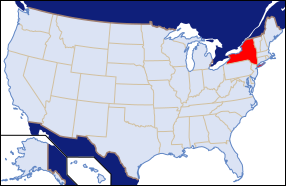
Map of the United States with New York highlighted

New York · Executive Law art. 15

New York ESA laws, layer by layer

New Yorkers are protected three times over: by the federal Fair Housing Act, by the State Human Rights Law, and — inside the five boroughs — by the NYC Human Rights Law. Each has its own reach and its own complaint route.

How the layers stack

Three bodies of law, one accommodation request

You do not choose between them. They apply simultaneously, and where they differ the most protective one generally governs.

Layer 1

Federal — Fair Housing Act

The nationwide baseline. Covers most rental housing, requires reasonable accommodation for assistance animals, removes pet rent and breed restrictions once approved, and limits what a housing provider may ask for. Enforced by HUD.

Gap: certain owner-occupied small buildings and specific categories fall outside federal coverage.

Layer 2

State — NY Human Rights Law

Runs in parallel and reaches some housing the federal exemptions leave out, giving New Yorkers coverage in buildings where the FHA alone would not help. Enforced by the New York State Division of Human Rights.

Why it matters: in a small building, this is often the layer that actually protects you.

Layer 3

City — NYC Human Rights Law

Inside the five boroughs, one of the broadest local civil rights laws in the country adds a further layer, with its own investigatory agency in the NYC Commission on Human Rights.

Why it matters: a local filing route that does not depend on a federal queue.

The New York-specific problem

Co-op boards, condo boards and house rules

Nowhere else in the country is so much housing governed by a board. New York co-op and condominium boards are generally subject to the same reasonable-accommodation duties as landlords — a no-pets house rule is not, on its own, a lawful basis for refusing an assistance animal.

Boards do tend to run a more formal process: a written request to the managing agent, a board meeting cycle, and sometimes an interview. Submit early, keep everything in writing, and do not let a "the board meets next month" response become an indefinite delay.

Submitting to a board

  1. Write to the managing agent, not a doorman or neighbour
  2. Attach the clinician letter and offer the verification route
  3. Ask for the board's decision date in writing
  4. Decline requests for medical records, politely and on paper
  5. Keep every message in one thread

If you are refused

Three places a New Yorker can file

More routes means more options, but each has its own deadline. Check the current filing window before you rely on one — they are not the same.

HUD

The federal route, available anywhere in the state. Handles Fair Housing Act complaints and can refer matters to state partners.

NYS Division of Human Rights

The state agency enforcing the Human Rights Law, including in buildings federal exemptions leave out. Typically a one-year filing window.

NYC Commission on Human Rights

For housing within the five boroughs. Investigates under the city law and can pursue remedies through its own process.

Deposits, pet rent and fees

Pet charges in New York, layer by layer

New York already caps security deposits at one month’s rent for most tenancies. An approved assistance animal accommodation then removes the pet-specific charges that sit on top of that cap.

Federal
Fair Housing Act

Removes pet rent, pet deposits and pet fees for an approved assistance animal in covered housing across the state.

State
Human Rights Law

Runs in parallel, reaches some buildings the federal exemptions leave out, and is enforced by the Division of Human Rights.

City
NYC Human Rights Law

Broader still inside the five boroughs, with its own Commission and a reputation for taking assistance animal complaints seriously.

What does not change: the one-month security deposit you would pay anyway, your rent, and your liability for damage the animal causes. New York’s deposit cap and its itemisation rules apply to you on exactly the same terms as any other tenant — an accommodation is not a discount.

Validity and renewal

Do New York ESA letters expire?

The legal answer

No. Neither the state Human Rights Law nor the NYC Human Rights Law sets a validity period for assistance animal documentation. There is no renewal date fixed in law.

The management-company answer

Roughly twelve months. New York co-op and condo boards in particular apply this informally, and boards are markedly less flexible about stale paperwork than individual landlords.

The board-package answer

If you are going through a co-op board package, assume the documentation will be read closely by someone looking for a reason to defer. Fresh beats old, every time.

Moving to New York?Get documentation from a New York–licensed clinician. An out-of-state letter is the most commonly refused kind here.
Renewal is a re-evaluationNot a reprint. A genuine renewal means a licensed professional has looked at your circumstances again.

Different pathway

Psychiatric service dogs in New York

Public access follows the ADA, and New York's civil rights provisions add their own protections for handlers of guide, hearing and service dogs. In practice a task-trained psychiatric service dog is treated as a service animal in shops, restaurants and on the subway.

An emotional support animal has no such access. In a city where you are constantly moving through public space, choosing the wrong category is a much more visible problem here than it is elsewhere.

Quick check

Need the animal with you on the subway and in shops? That is a trained-task question, not an ESA question.

Compare ESA and PSD Free screening

New York questions

Asked most often by New Yorkers

Can my co-op board refuse an emotional support animal?

Boards are generally subject to reasonable-accommodation duties under federal, state and, in the city, local human rights law. A no-pets house rule is not by itself a lawful basis for refusal, though the board may raise concerns about a specific animal's conduct.

Does New York give me more protection than federal law?

Yes. The State Human Rights Law reaches housing that federal exemptions leave out, and the NYC Human Rights Law adds a third layer inside the five boroughs with its own enforcement agency.

Where should I file a complaint?

HUD federally, the NYS Division of Human Rights at state level, or the NYC Commission on Human Rights for housing in the city. Deadlines differ, so confirm the current window rather than assuming.

Is there a waiting period for an ESA letter in New York?

New York does not impose California's 30-day relationship requirement. The clinician must be licensed in New York and the evaluation must be genuine, but there is no statutory waiting period.

My building says the ESA must use the service entrance.

Conditions that single out an assistance animal handler for different treatment are worth challenging in writing. Reasonable rules about conduct and care are legitimate; segregating you from other residents generally is not.

Do ESA letters expire in New York?

Indefinitely, as far as New York law is concerned — there is no statutory shelf life. Practical enforcement comes from property managers requiring reasonably recent documentation.

Do I have to pay pet rent or a pet deposit for an ESA in New York?

Not once the accommodation is approved. Charges that exist because an animal is a pet — pet rent, pet deposits, pet fees and breed surcharges — stop applying in New York. Your regular security deposit continues untouched, along with liability for anything the animal damages.

How quickly can I get ESA documentation in New York?

Allow the process a few days to run properly. A completed intake reviewed by a New York-licensed clinician typically issues within 24 to 48 hours. Any service promising an instant letter with no review is selling the kind of document New York landlords reject.

Is an out-of-state ESA letter valid in New York?

In practice, no. A New York landlord expects a New York-licensed clinician and can confirm that against the state board quickly. That single detail is enough for a refusal that will stand up.

Is there an official ESA registry or certificate in New York?

No. New York operates no emotional support animal registry, and no ID card, vest, certificate or registration number creates housing rights anywhere in the United States. Only the professional's letter is assessed, and the accompanying products have no standing.

Keep reading

Other state law guides

Get an ESA letter from a New York-licensed clinician

Your case routes to a professional whose licence covers New York. The screening is free — you only pay if you qualify and choose to continue.

Start free screening See pricing