"My Dallas complex has a 25lb weight limit"
Weight limits are pet policies. They are generally not applied to an approved assistance animal, and any objection has to rest on that individual animal's conduct rather than the number on the scale.

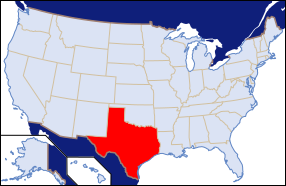
Texas · Human Resources Code ch. 121
Texas adds no waiting period to ESA documentation, so the federal standard applies directly. What Texas does add is a criminal penalty for passing an untrained animal off as a service animal.
The legal position
Human Resources Code § 121.006
Using a harness, leash or other equipment to represent that an animal is a service animal when it has not been trained as one is a misdemeanour. Conviction carries a fine and 30 hours of community service for an organisation serving people with disabilities.
The statute is aimed at fraud, but its practical effect is more scrutiny for everyone. Verifiable documentation and an accurate description of trained tasks are what separate you from the people the law targets.
Texas renters
Weight limits are pet policies. They are generally not applied to an approved assistance animal, and any objection has to rest on that individual animal's conduct rather than the number on the scale.
Deposits charged because an animal is a pet do not generally apply once the accommodation is approved. Ask in writing for the charge to be removed and reference the approval date.
They are entitled to reliable information that a disability-related need exists — not to your diagnosis or records. Offer the verification route on the letter instead.
Licensure follows where you live. A Texas landlord expects a Texas-licensed provider, and the good news is Texas has no 30-day rule, so a fresh letter moves faster here than it did there.
The cost column
Texas leaves deposits almost entirely to the contract, which makes tenants assume nothing can be challenged. The accommodation is the exception: it changes which contractual charges apply to you at all.
| Charge on a Texas lease | Before approval | After approval |
|---|---|---|
| Monthly pet rent | Payable | Does not apply |
| Non-refundable pet fee | Payable | Does not apply |
| Refundable pet deposit | Payable | Does not apply |
| Aggressive-breed surcharge | Payable | Does not apply |
| Security deposit | Payable | Still payable |
| Damage caused by the animal | Your liability | Still your liability |
Texas security deposit rules give a landlord 30 days after you surrender the property to refund or itemise. Pet charges wrongly withheld get tangled in that same window, which is why it is far cheaper to correct the ledger while you are still living there than to argue about it after you have moved out.
Validity, renewal and out-of-state letters
Legally, no. Chapter 121 sets no expiry date, and neither does any other Texas statute. There is no renewal deadline written into Texas law that you can miss.
Practically, yes. Texas leasing offices — particularly the large Dallas, Houston and Austin management companies that process accommodation requests at volume — work to an internal rule of thumb of roughly twelve months. Older documentation gets queried, and a query at lease-signing is the worst possible moment to discover yours is three years old.
Out of state is the real failure point. A letter from a clinician licensed in another state is the single most common reason a genuine Texas request is refused. Licensure follows where you live. If you moved to Texas, get Texas-licensed documentation before you need it rather than after a denial.
Different pathway
Public access in Texas follows the ADA: a dog individually trained to perform disability-related tasks, under the handler's control. Staff may ask only whether the dog is required because of a disability and what work or task it performs — not for documentation, and not for a demonstration.
Texas layers its own protections for assistance animals in public facilities and for trainers working with service animals in training, which federal law does not always reach.
Trained task on cue, or comfort from presence? The answer decides which evaluation you actually need — and they do not convert into one another.
Compare ESA and PSD Free screeningTexas questions
No. Texas imposes no minimum client-provider relationship, so the federal Fair Housing Act standard applies directly. The clinician must still hold a Texas licence, and the evaluation still has to be genuine — no waiting period is not the same as no review.
Under Human Resources Code 121.006 it is a misdemeanour, carrying a fine and 30 hours of community service for an organisation serving people with disabilities. The statute targets people presenting untrained animals as service animals.
Only for specific lawful reasons: the documentation is unreliable, that particular animal is a direct threat that cannot be reduced, it would cause substantial property damage, the accommodation is an undue burden, or the building is genuinely exempt. Simply having a no-pets policy is not among the valid grounds.
Reasonable-accommodation duties reach many homeowners-association situations, not just rentals. The request goes to the association through its written process the same way it would go to a landlord.
A mental health professional licensed in Texas — psychologist, LCSW, LPC, LMFT or psychiatrist, among others. What matters to a landlord is that the licence is real, current and checkable on the Texas licensing board.
Not legally. Texas has no provision expiring assistance animal documentation. The industry has converged on twelve months, and that convergence functions like a rule.
No. In Texas an approved assistance animal is not held as a pet under the pet policy, so the charges that policy generates come off your statement. Neither the standard deposit nor your damage liability changes.
The eligibility screening takes a few minutes. After that a Texas-licensed professional reviews your intake, and approved documentation is commonly delivered digitally within about 24 to 48 hours. A file that generates questions takes longer to close, and that is how it should work.
Effectively yes, they are state specific. The professional must be licensed to practise in Texas, which is exactly why instantly issued out-of-state letters fail here so consistently.
There is none. No Texas agency registers assistance animals or issues certificates, and sites selling registration numbers are selling accessories rather than rights. Registration numbers decide nothing; the letter decides everything.
Keep reading
Your case routes to a professional whose licence covers Texas. The screening is free — you only pay if you qualify and choose to continue.
Start free screening See pricing