Evaluation happens by telehealth
For most off-road communities there is no realistic in-person option. Licensure follows your location, so the clinician must be licensed for Alaska wherever they sit.

Alaska · AS 18.80
Most Alaskan communities cannot be reached by road, and a great deal of daily life happens on small aircraft. Both facts shape an ESA or PSD request here in ways that no guidance written for the Lower 48 accounts for.
Start free screening Off the road system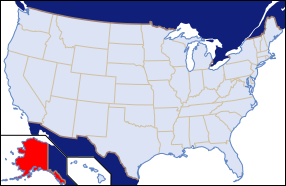
Alaska realities
None of these changes your rights. All of them change the logistics, and each is solvable with more lead time than a Lower 48 renter would ever need.
For most off-road communities there is no realistic in-person option. Licensure follows your location, so the clinician must be licensed for Alaska wherever they sit.
Regional carriers set their own animal requirements and space is genuinely limited. Advance notice is not a courtesy here, it is the difference between flying and not.
Village corporations, regional housing authorities and tribal entities administer a lot of Alaskan housing, each with their own process.
Freight, travel and appointments all slow in winter. Start earlier than you think you need to, particularly around a planned move.
Who administers your housing
In much of Alaska the decision-maker is not a conventional landlord. Regional housing authorities, village corporations and tribal entities each run their own programmes with their own written procedures, and sending a request to the wrong body simply delays it.
One phone call establishing who receives accommodation requests, and in what form, saves weeks. The clinician letter you need is the same document in every case.
Boundaries
A documented accommodation request must be considered on its merits
Reliable documentation may be requested where the need is not apparent
You remain responsible for damage the animal actually causes
Pet rent, pet fees or deposits once the accommodation is approved
Breed, weight or size restrictions applied to an assistance animal
Demands for your diagnosis, records or a registry listing
Deposits and pet rent
Alaska caps most residential security deposits at two months’ rent and sets deadlines for their return. Against Anchorage and Fairbanks rent levels, the pet charges layered on top are a larger sum than in most states — which makes the accommodation worth more here.
Charged because the animal is kept as a pet. Both stop applying once the accommodation is approved, whatever the pet addendum calls them.
Held specifically against animal damage and separate from your security deposit. It should be released or credited after approval — ask about it explicitly.
Charged of every Alaska tenant under the ordinary rules, and entirely unaffected by an accommodation.
Recoverable in full, assessed within Alaska’s statutory return deadlines. Nothing about an accommodation changes this.
Validity, renewal and telehealth
AS 18.80 sets no expiry date, and the Alaska State Commission for Human Rights operates no registry. Nothing lapses on a date — the twelve-month standard comes from housing providers.
Alaska’s real issue is not expiry but access. In much of the state, seeing a licensed clinician in person is impractical, which makes properly licensed telehealth the normal route rather than the exception. That is entirely legitimate, provided the professional holds a current Alaska licence.
Alaska licence. Not a Washington or Oregon one, however close the clinic felt.
A named professional. Signed, with licence type and number stated.
A recent date. Inside the twelve-month working window.
A verification route. Something that confirms the letter without opening your records.
Different pathway
Alaska follows the ADA for public access, and the Alaska Human Rights Law protects people with disabilities in housing and public accommodations.
Air carriers operating in Alaska follow federal DOT rules for service animals. On small regional aircraft, advance notice matters more than almost anywhere — space is genuinely limited and cannot be created on the day.
On small aircraft, advance notice is everything. Confirm carrier requirements before you book.
Compare ESA and PSD Free screeningAlaska questions
Yes. Telehealth is how most off-road residents are evaluated, and the clinician must be licensed for Alaska because licensure follows where you are located. Bandwidth varies enormously, so tell support in advance if video will be difficult.
Regional carriers set their own requirements and space on small aircraft is genuinely constrained. Contact the carrier well in advance rather than at the counter. A task-trained service dog is handled under federal DOT rules; an emotional support animal is generally treated as a pet.
The Alaska State Commission for Human Rights handles state complaints under AS 18.80, and HUD handles the federal route.
No. Approval takes the animal out of the pet category, so pet rent and pet deposits no longer apply to it. Alaska landlords facing high heating and maintenance costs sometimes keep billing anyway - raise it in writing and cite the approved accommodation. Damage the animal actually causes is still charged to you.
No. Alaska imposes no minimum client-provider relationship period. Your clinician must hold an Alaska licence and the evaluation must be genuine.
No Alaska statute sets an expiry date, so nothing lapses as a matter of law. Landlords set their own thresholds, and a year is where most of them draw it. Renew around month ten and the currency question never arises.
Screening happens on the spot, while the evaluation itself sets the pace. Most approved Alaska letters are delivered within a day or two of a completed intake, with anything requiring clarification taking longer.
It is the most commonly refused kind. Licensure follows where you live, so a Alaska housing provider checks that the clinician is licensed for Alaska and can verify it against the state board in minutes. If you have moved here, obtain fresh documentation from a Alaska-licensed professional before you need it.
Nothing requires them to, and most do not bother. A card, a certificate or a listing in an online register proves nothing in Alaska; a signed letter from a licensed professional is what a landlord actually assesses.
Alaska sets no cap. Each animal has to earn its place in the request, which means addressing them individually rather than as a group.
Keep reading
Your case routes to a professional whose licence covers Alaska. The screening is free — you only pay if you qualify and choose to continue.
Start free screening See pricing