
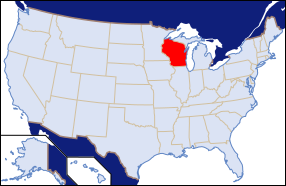
Wisconsin · § 106.50
Wisconsin ESA laws and the documentation standard
Wisconsin is one of a small group of states to write assistance animal documentation into the housing statute itself — and to attach a financial penalty to faking it. That combination makes document quality unusually decisive here.
Wisconsin penalises false assistance animal documentation
The statute reaches both the person supplying false documentation of a disability-related need and, in some circumstances, a person knowingly using it. This is not a state to experiment in with a purchased certificate.
Meeting the standard
What qualifies as documentation in Wisconsin
Wisconsin housing providers have a clearer statutory basis for asking than landlords in most states. These are the elements that satisfy the request without going beyond what they are entitled to.
A licensed professional
Qualified to assess your condition and licensed in Wisconsin. A certificate vendor is not a licensed professional.
A disability-related need
A statement connecting the animal to a disability-related need — not a diagnosis, and not a description of your treatment.
Current and signed
A recent date and a signature. Stale documentation is the most common soft rejection in Wisconsin.
Your medical records
The statute contemplates confirmation of a need, not access to your chart. Decline records requests in writing.
A registry entry or ID card
No Wisconsin registry creates rights. A card is an accessory and satisfies nothing in the statute.
Training for the animal
An emotional support animal needs no training. That requirement belongs to the service dog pathway.
If you are refused
Filing in Wisconsin
Wisconsin runs its fair housing enforcement through the Equal Rights Division rather than a standalone civil rights commission, and Madison and Milwaukee add local routes on top.
- Get the refusal in writingWith its stated reason, if one is given.
- Answer with verification, not recordsPoint at the route on the document and decline records requests on paper.
- File with the Equal Rights DivisionDepartment of Workforce Development, under Wisconsin’s open housing law.
- Consider HUD in parallelThe federal route stays open regardless of the state filing.
- Check for a local bodyMadison and Milwaukee operate their own civil rights offices.
After the standard is met
Wisconsin pet deposits and pet rent
Wisconsin’s Open Housing Law is explicit that a landlord may not charge extra for keeping an assistance animal, while preserving the right to recover for damage the animal actually causes. That is the whole rule in one sentence.
- Pet rent, monthly or otherwise
- Pet deposits, refundable or not
- One-off pet or animal fees
- Breed, size or weight surcharges
- Extra charges for a second assistance animal
- Recovery for damage the animal causes
- The standard security deposit
- Rent, utilities and fixed charges
- Enforcement against genuinely dangerous conduct
- Everything else in the tenancy
Charged anyway? The Equal Rights Division of the Department of Workforce Development handles Open Housing complaints, and HUD remains available in parallel.
Validity and renewal
How current does Wisconsin documentation need to be?
Wisconsin sets a documentation standard but not a documentation clock. Nothing in § 106.50 expires your letter — yet the same reliability logic that governs what a letter must contain also shapes how old it can be before a landlord doubts it.
Accepted without comment by essentially every Wisconsin housing provider. This is where you want to be.
Increasingly likely to draw a request for something more recent, particularly at lease renewal.
Expect to be asked for current documentation. Nothing has legally lapsed, but the reliability argument has weakened.
Wisconsin licensure is checked as closely as currency — an out-of-state clinician is the most common single reason a Wisconsin request is refused.
Different pathway
Psychiatric service dogs in Wisconsin
Wisconsin follows the ADA for public access, and state law protects handlers of service animals in places of public accommodation. Wisconsin also addresses misrepresentation of service animals.
Because Wisconsin has legislated on documentation, keeping the ESA and PSD categories clearly separate matters more here than in states that leave it to practice.
Quick check
Wisconsin attaches a penalty to false documentation. Claim only the category your situation actually supports.
Compare ESA and PSD Free screeningWisconsin questions
Asked most often in Wisconsin
What documentation does Wisconsin require for an ESA?
Wisconsin’s open housing law contemplates documentation from a licensed professional confirming a disability-related need for the animal, where the disability is not apparent. It is more specific than most states, which is why generic online certificates fail here.
Is there a penalty for fake ESA documentation in Wisconsin?
Yes. Wisconsin attaches a monetary penalty to knowingly providing false documentation of a disability-related need for an assistance animal. It applies to the person supplying it and can reach a person knowingly using it.
Who investigates housing discrimination in Wisconsin?
The Equal Rights Division of the Department of Workforce Development handles state fair housing complaints, and HUD handles the federal route. Madison and Milwaukee also have local civil rights bodies.
Can a Wisconsin landlord charge pet rent for an approved ESA?
No. Approved assistance animals are exempt from pet rent and pet deposits. In Wisconsin the Equal Rights Division within the Department of Workforce Development takes these complaints. Anything beyond routine wear remains billable to the tenant.
Which professionals can write an ESA letter in Wisconsin?
A licensed professional qualified to assess your condition — typically a psychologist, licensed clinical social worker, professional counsellor, marriage and family therapist, psychiatrist or physician, licensed in Wisconsin.
How long does an ESA letter last in Wisconsin?
Not legally. Wisconsin has no provision expiring assistance animal documentation. What governs is convention rather than legislation, and the convention lands at about twelve months.
How long does it take to get an ESA letter in Wisconsin?
The eligibility screening takes a few minutes. After that a Wisconsin-licensed professional reviews your intake, and approved documentation is commonly delivered digitally within about 24 to 48 hours. Extra questions mean extra days, and also mean the review was not a formality.
Can my ESA letter come from a clinician in another state if I live in Wisconsin?
Effectively yes, they are state specific. The professional must be licensed to practise in Wisconsin, which is exactly why instantly issued out-of-state letters fail here so consistently.
Do Wisconsin landlords accept ESA ID cards or registration numbers?
There is none. No Wisconsin agency registers assistance animals or issues certificates, and sites selling registration numbers are selling accessories rather than rights. Only the clinician's document has legal relevance to the request.
Can I have more than one emotional support animal in Wisconsin?
There is no numerical limit in Wisconsin law. Multiple animals can be justified individually, and a housing provider may examine each justification. A request built animal by animal is much harder to dismiss.
Keep reading
Other state law guides
Get an ESA letter from a Wisconsin-licensed clinician
Your case routes to a professional whose licence covers Wisconsin. The screening is free — you only pay if you qualify and choose to continue.
Start free screening See pricing