South Carolina · SCHAC

South Carolina ESA laws and what to say back

South Carolina tracks federal law closely, so most disputes here are won or lost on how you respond rather than on any state quirk. These are the six things landlords say, and the written reply to each.

Start free screening The scripts
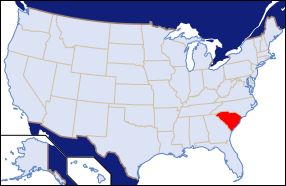
Map of the United States with South Carolina highlighted

Copy these

Six objections, six written replies

Send every one of these by email rather than saying it at the leasing desk. The point is not to win an argument in the moment — it is to create a dated record that makes the argument unnecessary.

They say

“We have a strict no-pets policy.”

You write

“I am not requesting permission to keep a pet. I am requesting a reasonable accommodation for an assistance animal under fair housing rules, supported by documentation from a licensed professional, which I have attached.”

They say

“That breed is not permitted here.”

You write

“Breed restrictions are pet policies and are generally not applied to an approved assistance animal. If there is a specific concern about this animal’s conduct, I am glad to discuss it.”

They say

“You will need to pay the pet deposit.”

You write

“Fees charged because an animal is a pet do not generally apply to an approved assistance animal. I remain responsible for any actual damage, and I am happy to confirm that in writing.”

They say

“Send us your medical records.”

You write

“I am able to provide documentation of a disability-related need, which I have attached, and it can be verified directly. I am not able to share clinical records or a diagnosis.”

They say

“This letter looks like one of those online ones.”

You write

“The clinician is named on the document with their South Carolina licence details, which you can check with the state board, and there is a verification route printed on it. Please let me know if anything further is needed.”

They say

“We are still reviewing it.” (for weeks)

You write

“Following up on my request of [date]. Could you confirm a decision date? If anything further is required from me, please let me know in writing.”

The one rule

Never negotiate an accommodation verbally

Every script above works because it produces a dated record. A South Carolina landlord who refuses in writing has given you the basis of a complaint; one who refuses in a corridor has given you nothing. If a conversation happens by phone, summarise it in an email the same day.

If the scripts do not work

Escalating in South Carolina

SC Human Affairs Commission

The state agency handling fair housing complaints. Attach the written record your scripts produced.

HUD

The federal route, independent of the state one. Filing with SCHAC does not close it.

Keep the animal in place

Removing the animal while a documented request is pending weakens your position considerably.

Another script — for the money

Getting South Carolina pet charges removed

You have the reply scripts above for the documentation conversation. This is the one for the billing conversation, which is a different department and usually a much shorter exchange.

Send to the leasing office, not the maintenance line

“My reasonable accommodation for an assistance animal at [unit] was approved on [date]. The statement for [month] still shows pet rent of [amount], and a pet fee of [amount] was collected at move-in. As these are charges under the pet policy, they should not apply to an approved assistance animal. Please remove the recurring charge from the next statement and confirm how the amounts already collected will be credited. I remain responsible for any damage caused by the animal.”

What not to ask for: a waiver of your security deposit, a rent reduction, or release from damage liability. None of those follow from an accommodation, and asking for them undermines an otherwise straightforward request. The South Carolina Human Affairs Commission takes the accurate version of this complaint seriously.

Validity and renewal

“Your letter has expired” — and how to answer it

The claim: South Carolina law requires an ESA letter to be renewed annually.

The reality: it does not. The South Carolina Fair Housing Law sets no validity period and no state agency registers or dates these letters. The annual convention comes from housing providers.

The sensible reply: “There is no statutory expiry date, but I am happy to provide current documentation. Attached is a letter dated [date] from [clinician], licensed in South Carolina, with a verification contact.”

Why concede the point: because arguing that a three-year-old letter must be accepted wins the principle and loses the tenancy. Providing something current costs a review and ends the conversation immediately.

Different pathway

Psychiatric service dogs in South Carolina

South Carolina follows the ADA for public access, and state law addresses the rights of people with disabilities accompanied by service animals in public places.

The scripts on this page are written for housing. Public access is a training question rather than a documentation question, and no reply script substitutes for a trained task.

Quick check

These scripts work for housing. If the dispute is about a shop or restaurant, you are in service dog territory.

Compare ESA and PSD Free screening

South Carolina questions

Asked most often in South Carolina

What should I say when my landlord says "no pets"?

Reply in writing: you are requesting a reasonable accommodation for an assistance animal, not permission to keep a pet, and a no-pets policy is not by itself a lawful basis for refusal in covered housing. Attach the clinician letter and offer the verification route.

Who investigates housing discrimination in South Carolina?

The South Carolina Human Affairs Commission handles state fair housing complaints, and HUD handles the federal route. Both are available and independent.

Can a Charleston or Columbia landlord charge pet rent for an approved ESA?

No. Fees that exist because an animal is a pet normally cease on approval. Damage caused by the animal remains a cost you carry.

Does South Carolina require a waiting period for an ESA letter?

No. South Carolina imposes no minimum client-provider relationship period. Your clinician must hold a South Carolina licence.

Should I ever discuss this by phone?

Have the conversation if you like, then send a short email summarising what was said and agreed. Verbal agreements about accommodations are impossible to enforce and impossible to prove.

How long does an ESA letter last in South Carolina?

Not legally. South Carolina has no provision expiring assistance animal documentation. Instead there is a widely shared one-year assumption that shapes how requests are received.

How long does it take to get an ESA letter in South Carolina?

The eligibility screening takes a few minutes. After that a South Carolina-licensed professional reviews your intake, and approved documentation is commonly delivered digitally within about 24 to 48 hours. Where the clinician needs to ask something further, add time and take it as a good sign.

Can my ESA letter come from a clinician in another state if I live in South Carolina?

Effectively yes, they are state specific. The professional must be licensed to practise in South Carolina, which is exactly why instantly issued out-of-state letters fail here so consistently.

Do South Carolina landlords accept ESA ID cards or registration numbers?

There is none. No South Carolina agency registers assistance animals or issues certificates, and sites selling registration numbers are selling accessories rather than rights. The request stands or falls on the clinical letter.

Can I have more than one emotional support animal in South Carolina?

There is no numerical limit in South Carolina law. Several animals may be documented where each relates to the disability, and each is fairly open to questions. The more specific the letter is about each animal, the better it holds.

Keep reading

Other state law guides

Get an ESA letter from a South Carolina-licensed clinician

Your case routes to a professional whose licence covers South Carolina. The screening is free — you only pay if you qualify and choose to continue.

Start free screening See pricing