Contractual pet terms — displaced
These exist because the lease treats the animal as a pet. Once the accommodation is approved, that characterisation no longer fits.
- Monthly pet rent
- Pet deposit
- Non-refundable pet fee
- Breed and weight restrictions

Louisiana · Civil Code
Louisiana is the only U.S. state whose private law descends from the Napoleonic tradition rather than English common law. Your federal disability rights are unaffected — but the lease sitting underneath them is not the document a Texan tenant has.
Free eligibility check What changes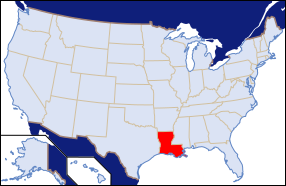
Separating the two layers
Almost every mistake we see from Louisiana renters comes from mixing these up — either assuming the civil code weakens their ESA rights, or assuming generic online lease advice applies here. Neither is true.
A great deal of tenant advice online describes common-law procedure that does not map onto Louisiana. The disability-law half of that advice is usually fine; the lease and eviction half frequently is not. When the two are mixed in one article, treat the procedural part with suspicion.
Making the request
Licensure follows where you live. A Louisiana landlord can check the credential with the state board directly.
Email the landlord or management company requesting a reasonable accommodation for an assistance animal, letter attached.
Point at the route on the document rather than supplying records. It answers authenticity without disclosing anything clinical.
Approval or refusal with a reason. Under any legal system, this is the document that matters later.
Louisiana Commission on Human Rights, HUD federally, or the New Orleans human rights body if you are in the city.
The lease, and what sits outside it
Louisiana’s civil law tradition makes the lease itself unusually central. That cuts both ways here: the pet addendum is a contractual term, and an approved accommodation changes which of its terms can be applied to you.
These exist because the lease treats the animal as a pet. Once the accommodation is approved, that characterisation no longer fits.
These arise from the tenancy itself and are entirely unaffected by how the animal is characterised.
New Orleans, Baton Rouge and Shreveport leases vary considerably in how these charges are worded. The label matters less than the reason for the charge.
Validity and renewal
No. The Louisiana Equal Housing Opportunity Act sets no validity period, and no Louisiana agency dates or registers assistance animal documentation.
Sometimes yes. Some Louisiana leases write an annual documentation review into the pet addendum, and a contractual term is a different animal from a statutory one — read yours.
Twelve months. Whether or not your lease says so, a Louisiana housing provider will treat older documentation as no longer evidence of a current need.
A Louisiana-licensed clinician is what withstands scrutiny here; out-of-state documentation is the version most often refused.
Different pathway
Louisiana follows the ADA for public access, and state law protects people accompanied by service animals in places of public accommodation, with penalties for misrepresentation.
Federal disability law applies identically in Louisiana. It is the lease and property law underneath — not the disability law — that follows the civil code.
The civil code changes lease mechanics, not the ADA. Task training still decides public access.
Compare ESA and PSD Free screeningLouisiana questions
No. The Fair Housing Act and the ADA are federal and apply identically in Louisiana. What differs is the surrounding lease and property law, which follows the Louisiana Civil Code rather than the common law used in the other 49 states.
Louisiana uses different terminology and different default rules for leases, notice and eviction than common-law states. Advice written for a Texas or Florida tenant may not describe Louisiana procedure correctly, even when the disability law part is right.
The Louisiana Commission on Human Rights handles state-level complaints and HUD handles the federal route. New Orleans also has its own human rights body.
No. Pet rent and deposits cease once the accommodation is approved. Louisiana's Commission on Human Rights takes state complaints, though many residents go directly to HUD. Repair costs for actual damage are unaffected.
No. Louisiana imposes no minimum client-provider relationship period. Your clinician must hold a Louisiana licence and the evaluation must be genuine.
Indefinitely, as far as Louisiana law is concerned — there is no statutory shelf life. The constraint is commercial rather than legal, and it usually lands at documentation under a year old.
Think in days; anyone promising minutes is not reviewing anything. A completed intake reviewed by a Louisiana-licensed clinician typically issues within 24 to 48 hours. Any service promising an instant letter with no review is selling the kind of document Louisiana landlords reject.
In practice, no. A Louisiana landlord expects a Louisiana-licensed clinician and can confirm that against the state board quickly. A credential from another state is an easy no that is hard to argue with.
No. Louisiana operates no emotional support animal registry, and no ID card, vest, certificate or registration number creates housing rights anywhere in the United States. The letter is what is weighed, and everything marketed alongside it is legally inert.
More than one is possible in Louisiana, but each animal has to be justified. Generic references to household pets are the weakest form of request.
Keep reading
Your case routes to a professional whose licence covers Louisiana. The screening is free — you only pay if you qualify and choose to continue.
Start free screening See pricing