
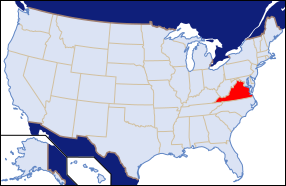
Virginia · § 36-96.3:1
Virginia ESA laws and what your letter must show
Virginia is one of the few states to write assistance animal documentation into the housing statute itself. Section 36-96.3:1 sets out how a request is made, what supporting information may be required, and the timeline a housing provider works to.
Free eligibility check- 0136-96.3:1The statute governing assistance animal requests
- 02DPORVirginia Fair Housing Office investigates
- 03ReliableThe documentation standard set by statute
Anatomy of the document
What a Virginia housing provider reads, line by line
Because Virginia wrote assistance animal documentation into the housing statute, Virginia property managers tend to read the letter more carefully than most. Here is what each part is doing.
- Who wrote it. A named professional, not a website or a certificate mill. This is the first thing checked.
- Is the licence real and local. Virginia boards publish licence lookups; a Virginia credential is checkable in about a minute.
- The need, not the diagnosis. The statute contemplates reliable information about a disability-related need — not your medical file.
- Which animal. Requests covering more than one animal invite questions about each, so specificity helps.
- Currency. A stale letter is the most common soft rejection. Most providers expect something within about a year.
- Provable. Verification answers the authenticity question without disclosing anything clinical about you.
How the request runs
Virginia’s statutory request process
Virginia is unusual in setting expectations for both sides in statute. That cuts both ways: the housing provider has clearer authority to ask, and you have clearer grounds to refuse what falls outside it.
- 1You make a written requestReasonable accommodation for an assistance animal, with documentation attached.
- 2The provider may seek reliable informationOnly where the disability or the need is not readily apparent.
- 3You supply the clinician letterNot medical records. Offer the verification route if authenticity is questioned.
- 4The provider evaluates and respondsGet the decision in writing, with a reason if it is a refusal.
- 5Escalate if refusedVirginia Fair Housing Office, or HUD federally — both routes stay open.
Boundaries
What a Virginia landlord may and may not do
- ✓Require reliable supporting documentation where the need is not apparent
- ✓Verify the clinician's Virginia licence
- ✓Ask about each animal where several are requested
- ✗Charge pet rent, a fee or a deposit once approved
- ✗Demand your diagnosis or medical records
- ✗Require a specific vendor, registry or product
Anatomy of the ledger
Reading a Virginia lease for pet charges
Virginia’s Residential Landlord and Tenant Act governs deposits generally. Pet charges live in a separate addendum, and that addendum is where an approved accommodation does its work.
“Pet rent”
Monthly, per animal, often $25–$50 in Northern Virginia buildings.
Does not apply after approval“Pet deposit”
Held against animal damage specifically, separate from the security deposit.
Does not apply after approval“Pet fee”
One-off and non-refundable, charged at move-in.
Does not apply after approval“Security deposit”
Charged to every tenant under the Landlord and Tenant Act.
Unaffected“Damages”
Assessed at move-out against the condition report.
UnaffectedValidity and renewal
Does a Virginia ESA letter expire?
Virginia Code § 36-96.3:1 sets out what a landlord may request and how quickly they must respond. What it does not do — and what no Virginia statute does — is put an expiry date on your documentation.
Different pathway
Psychiatric service dogs in Virginia
Virginia follows the ADA on public access and separately protects service dog handlers under state law, with penalties for misrepresenting an animal as a service animal.
Because Virginia has legislated so specifically about assistance animal documentation in housing, keeping the ESA and PSD categories distinct matters more here than in states that stay silent on the subject.
Quick check
Virginia legislated the housing paperwork. Public access still turns on training, not documents.
Compare ESA and PSD Free screeningVirginia questions
Asked most often in Virginia
What does Virginia Code 36-96.3:1 require?
It sets out how an assistance animal request is handled in housing, including that a housing provider may require reliable supporting documentation of the disability-related need where it is not readily apparent, and the process around that request.
Who investigates fair housing complaints in Virginia?
The Virginia Fair Housing Office, part of the Department of Professional and Occupational Regulation, investigates under state law, and HUD handles the federal route.
Can a Virginia landlord charge pet fees for an approved ESA?
No. Pet rent, pet fees and pet deposits generally do not apply once the accommodation is approved. You remain responsible for actual damage.
Does an out-of-state letter work in Virginia?
Virginia housing providers look for reliable documentation from a clinician licensed to serve you. An out-of-state instant letter is the version most often refused here.
Is there a waiting period for a Virginia ESA letter?
Virginia does not impose a California-style 30-day rule, but it does set expectations about the reliability of documentation, which effectively rules out no-contact instant letters.
Is there an expiry date on a Virginia ESA letter?
No Virginia statute sets an expiry date, so nothing lapses as a matter of law. Housing providers judge for themselves, and a year is the usual point of refusal. Keeping the letter under a year old sidesteps the question entirely.
What is the turnaround for a Virginia ESA evaluation?
The screening is over in minutes, the review is measured in days. Most approved Virginia letters are delivered within a day or two of a completed intake, with anything requiring clarification taking longer.
Do I need to register my ESA or buy an ID card in Virginia?
The document means nothing to them, and they are right to say so. A card, a certificate or a listing in an online register proves nothing in Virginia; a signed letter from a licensed professional is what a landlord actually assesses.
How many ESAs can one person have in Virginia?
Virginia sets no cap. Address each animal distinctly; a grouped reference weakens the whole request.
Does a Virginia ESA letter have to come from a therapist?
A mental health professional licensed in Virginia and qualified to assess your condition — typically a psychologist, licensed clinical social worker, professional counsellor, marriage and family therapist or psychiatrist. What matters to a housing provider is that the credential is current, named and checkable against the Virginia licensing board.
Keep reading
Other state law guides
Get an ESA letter from a Virginia-licensed clinician
Your case routes to a professional whose licence covers Virginia. The screening is free — you only pay if you qualify and choose to continue.
Start free screening See pricing