County human relations office
Montgomery, Prince George’s, Howard and several other Maryland counties run their own offices with local investigators and shorter queues. If your building sits in one of them, start here.

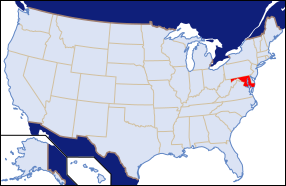
Maryland · MCCR
Maryland renters frequently have three doors to knock on rather than one: a state commission, a county human relations office, and HUD. Knowing which is fastest is most of the advantage.
Free eligibility checkChoosing a door
These are independent of each other. Filing with a county office does not close the state or federal route, and many Maryland disputes resolve before the second door is needed.
Montgomery, Prince George’s, Howard and several other Maryland counties run their own offices with local investigators and shorter queues. If your building sits in one of them, start here.
The MCCR investigates housing discrimination anywhere in Maryland under state law. It is the route for counties without their own office, and it works in parallel with the federal one.
The Fair Housing Act route, available regardless of county. Slower in most cases, but it remains open even after a state or county filing.
The commuter problem
Corridor renters constantly cross jurisdictions, and the assumption that a letter travels with them is the most expensive mistake we see in this region.
Boundaries
Same rule, three jurisdictions
Maryland caps security deposits by statute and requires interest to be paid on them. Pet charges sit outside that regime — and outside it in every county, which makes this one of the few rules that does not change as you move along the corridor.
Pet rent and pet deposits come off on approval. The city’s own civil rights office adds a further complaint route if they do not.
Same outcome, with the county’s Office of Human Rights as an additional and notably active enforcement body.
Same outcome again, with its own human relations commission alongside the state and federal routes.
Everywhere in Maryland: the statutory security deposit cap applies to you unchanged, interest accrues on it as normal, and you remain fully liable for damage the animal causes. What the accommodation removes is the pet addendum — pet rent, pet deposit, pet fee and breed surcharge — not the tenancy itself.
Validity, renewal and crossing state lines
No Maryland statute expires ESA documentation, and the Maryland Commission on Civil Rights operates no registry that would date one. Housing providers supply the deadline instead, and they generally settle on twelve months.
Maryland renters move between the District, Virginia and Maryland more than almost anyone else in the country — and licensure does not travel with them. A letter written by a DC-licensed or Virginia-licensed clinician is exactly the kind a Maryland landlord queries. If you crossed a line in this corridor, get documentation from a Maryland-licensed professional before your next lease, not after the first refusal.
Renew at around ten months, and treat a renewal as a fresh clinical review rather than a reissue of the same document.
Different pathway
Maryland follows the ADA for public access and adds state protections for handlers of service animals in public accommodations, along with penalties for misrepresentation.
If you commute between Maryland, DC and Virginia, remember that ADA access travels with you but your clinician\u2019s licence does not. Licensure follows where you live.
Commuting across the corridor? Access rules follow the ADA everywhere; your letter follows your home state.
Compare ESA and PSD Free screeningMaryland questions
The Maryland Commission on Civil Rights investigates statewide, several counties including Montgomery, Prince George\u2019s and Howard operate their own human relations offices, and HUD handles the federal route. Local offices are frequently faster.
Your housing accommodation is governed where you live, and your clinician must be licensed for Maryland. Where you work does not change either.
No. Approved assistance animals are exempt from pet rent, pet deposits and weight or breed surcharges. The Maryland Commission on Civil Rights handles continued charging as discrimination. Damage costs are separate and still yours.
No. Maryland imposes no minimum client-provider relationship period. Your clinician must hold a Maryland licence and the evaluation must be genuine.
It can help. Several Maryland counties run their own human relations commissions with local investigators, which often means a faster route than a statewide or federal queue.
Indefinitely, as far as Maryland law is concerned — there is no statutory shelf life. Property managers impose the effective cutoff, generally declining anything older than about a year.
Allow several days rather than expecting it before dinner. A completed intake reviewed by a Maryland-licensed clinician typically issues within 24 to 48 hours. Any service promising an instant letter with no review is selling the kind of document Maryland landlords reject.
In practice, no. A Maryland landlord expects a Maryland-licensed clinician and can confirm that against the state board quickly. It gives the property manager a straightforward and legitimate basis to say no.
No. Maryland operates no emotional support animal registry, and no ID card, vest, certificate or registration number creates housing rights anywhere in the United States. Housing providers assess the clinical letter. Cards, tags and certificates carry no legal force.
More than one is possible in Maryland, but each animal has to be justified. A catch-all phrase in place of specifics invites a refusal.
Keep reading
Your case routes to a professional whose licence covers Maryland. The screening is free — you only pay if you qualify and choose to continue.
Start free screening See pricing