
How to get a psychiatric service dog
Documentation, then training, then proofing the work until it survives a busy supermarket. Reckon on eighteen months to two years, an outlay of either substantial money or substantial time, and the real possibility that this particular dog never gets there. Here is the whole route with nothing left out.
Covered honestly
- Six stages, with realistic timings
- What each route actually costs
- Six checks to run before committing to a dog
- The truth about free service dogs
How to get a service dog, honestly
Searches for how to get a service dog free in Michigan or Texas expect a charitable route, and one genuinely exists. What nobody mentions is that the waiting lists run to years and most applicants are turned down.
- Documentation, training, then proofing
- What each route really costs
- The truth about free placements
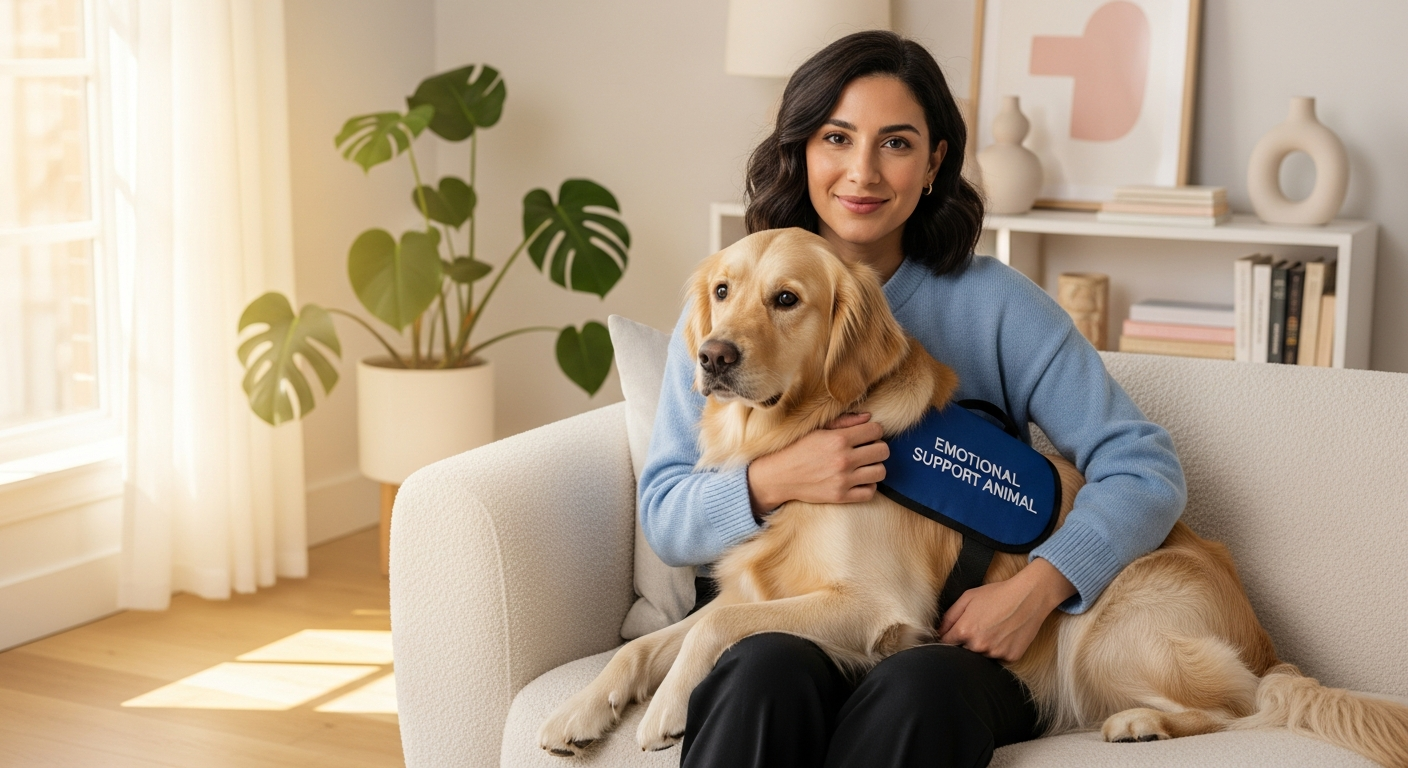 The vest is the easy part to acquire and the least meaningful. What counts is the eighteen months of training it should represent.
What it takes
The path, stage by stage
Nobody publishes this sequence with honest timings attached, which is why expectations start wrong so often.
- Stage one
Documentation of the disability
A licensed clinician establishes that a disability exists and that trained assistance would address part of it. Days, not months. Programmes require it before they will consider an application.
- Stage two
Choose your route
Owner-training or a programme placement. Programmes give you a finished dog after a long wait; owner-training gives you control and a longer, harder road. Apply to programmes even if you intend to owner-train, because the wait runs in parallel.
- Stage three
Temperament assessment
Before investing a year, find out whether this dog can work at all. A trainer experienced with service dogs can tell you a great deal in one session, and an early honest answer is worth more than optimism.
- Stage four
Task training
Building the specific behaviours - deep pressure, interruption, retrieval, room checks. Six to twelve months for a solid repertoire, done properly with cues and releases.
- Stage five
Public access proofing
Making the work survive distraction. Shops, transport, crowds, other dogs. This is where most owner-trained teams stall and it cannot be compressed.
- Ongoing
Maintenance and reassessment
Trained behaviour decays without rehearsal. Handlers treat this as permanent upkeep rather than a phase with an end.
Two routes, two economies
What it actually costs
Neither column includes the ordinary cost of keeping a dog, which runs alongside both for the animal's whole life.
Owner-training
- Temperament assessment with a service dog trainer
- Group obedience, then private task sessions
- Equipment - harness, leads, long lines
- Veterinary care, including hip and elbow screening
- Your own time, measured in hours per week for two years
- The real risk that the dog washes out mid-way
Programme placement
- Application, references and assessment
- A waiting list commonly measured in years
- Either no fee at all, or a very substantial one
- Residential handover training, often two weeks away from home
- Travel and accommodation for that handover
- Ongoing programme requirements and follow-up
Six honest checks
Before you commit to a dog
Every one of these is easier to answer now than eighteen months in.
- 01
Can you rehearse in public regularly?
Proofing needs shops, transport and crowds, repeatedly. Without access to those, task work stays theoretical.
- 02
Is the dog neutral about strangers?
A dog that wants to greet everyone is not going to settle under a cafe table. This is temperament, not training.
- 03
How does it recover from a fright?
Every working dog gets startled. What matters is whether it resets in seconds or stays rattled for an hour.
- 04
Can you afford the vet bills?
Working dogs need to be sound. Screening, and treating what screening finds, is not optional.
- 05
Will you stop if it is not working?
Washing out is common. Deciding in advance that you will accept that answer protects both of you.
- 06
Is a support animal actually enough?
For many people it is, and it is available in days rather than years. Ask the question before starting a two-year project.
Answered directly
The free service dog question
This phrase drives a great deal of the search traffic to this subject, and it deserves a straight answer rather than a deflection.
Are free service dogs real?
What is the catch?
Should I apply even if I might train my own?
What about cheap trained service dogs advertised online?
Is there a free route to the documentation stage?
Ten answers
Getting a psychiatric service dog
How do I get a psychiatric service dog?
It runs in three parts. A licensed clinician documents the disability; the dog is trained, whether by you or by a programme; and the work is then rehearsed until it survives a public place. There is no shortcut through any of them.
How do I get a service dog for free?
Charitable programmes and veterans' organisations place trained dogs without charge. They are real, they are excellent, and their waiting lists run to years. Applying early costs nothing and is the only honest route to a free trained dog.
Can I train my own?
Yes. Owner-training is permitted everywhere in the United States and many successful teams are owner-trained. It demands more time and more honesty about your dog's suitability than most people anticipate.
How long does it take?
Eighteen months to two years is a realistic span for owner-training to dependable public work. Programme dogs arrive trained but the wait to receive one is comparable, so the calendar is similar either way.
What does it cost?
Owner-training with professional support commonly runs into several thousand dollars once classes, equipment and veterinary costs are counted. Programme dogs are either free with a long wait or cost tens of thousands.
Does my dog need to be a particular breed?
No breed is required or excluded. Temperament decides it - a dog that is neutral about strangers, unbothered by noise and recovers quickly from surprise. Plenty of dogs from suitable breeds still wash out.
What is washing out?
When a dog turns out to be unsuited to public work and training stops. It is common, it is nobody's fault, and continuing anyway produces an unreliable team. The dog usually stays as a much-loved pet.
Do I need documentation before training?
Not legally, but every programme asks for it and it is sensible regardless. It establishes that the work you are training addresses an actual disability, which is the foundation the whole thing rests on.
Is there a test I have to pass?
No official one exists in the United States. Some handlers use a public access assessment offered by trainers as a private benchmark. It carries no legal status but it is a genuinely useful measure of readiness.
Can a landlord or airline demand proof of training?
Housing follows accommodation rules. For public access, staff may ask what work the dog performs - a question you answer in words, not with a document. Airlines require their own forms, which changed in 2021 and are stricter than they once were.
Stage one is the same either way.
Whether you train your own or join a programme waiting list, both start with documentation of the underlying need. Begin there at no cost.